
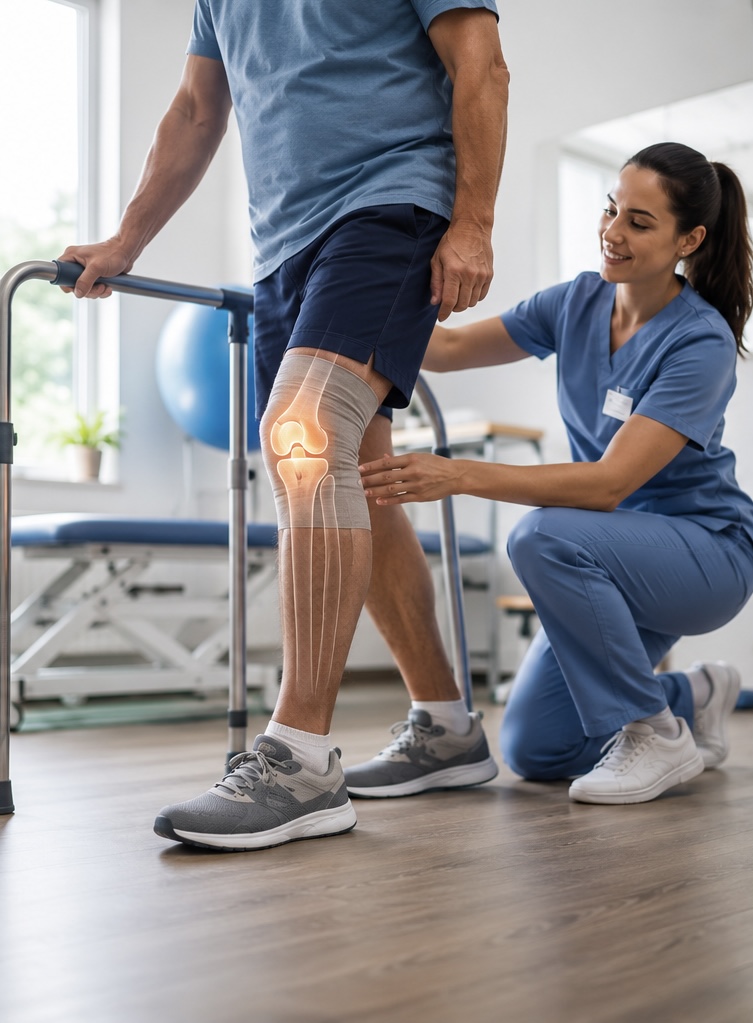
Rehabilitation
What to expect in the first 6 weeks after a knee replacement
Milestones, exercises and red flags to guide your recovery in the critical first six weeks after a total knee replacement.
The first 6 weeks set the tone for the next 12 months
The range of motion you achieve in the first 6 weeks after a total knee replacement strongly predicts your long-term function. This window is uncomfortable, but it is also the most important phase of your rehabilitation. Consistent daily work — not heroic single sessions — is what produces a great outcome.
Weeks 1–2 — Pain and swelling control
Focus on swelling control, achieving full knee extension (a straight knee), and 0–90° of flexion. Walking with crutches or a frame is normal. Ice and elevate for 20 minutes, 3–4 times per day, especially after exercise.
Weeks 3–4 — Increasing bend and strength
Progress to 100–110° of flexion, wean off walking aids and begin climbing stairs one step at a time. Quad sets, heel slides, straight leg raises and seated knee bends should be performed 3–5 times daily — short, frequent sessions outperform long, occasional ones.
Weeks 5–6 — Functional strengthening
Target 115–120° flexion, walk unaided indoors, return to driving (with surgeon clearance) and progress to longer outdoor walks. Functional strengthening, stair training and balance exercises start to dominate the programme.
Red flags — when to call your surgeon
Calf pain, swelling or warmth (possible DVT). Fever or wound discharge. Sudden loss of range of motion. Pain that is worsening rather than improving week over week. Any of these warrant urgent medical review.
Key takeaways
- The first 6 weeks determine your 12-month outcome — protect this window.
- Full extension matters as much as bending — do not neglect the straight knee.
- Short, frequent sessions beat long, occasional ones.
Next step
Book your post-operative rehabilitation assessment with KineticCare Physiotherapy in Umhlanga.
Related services
Hands-on care at our Umhlanga practice for this concern.
Post-Surgical Rehabilitation
Structured recovery after orthopaedic surgery — hip and knee replacements, ACL reconstructions, shoulder repairs and more.
Manual Therapy
Hands-on joint mobilisation and soft tissue techniques to restore movement and reduce pain.
Chronic Pain Management
An evidence-based plan to reduce long-term pain, restore function and rebuild confidence in movement.
Philani Sabela
Physiotherapist · KineticCare Physiotherapy (Pty) Ltd
PR No: 1324934 · Umhlanga, Durban, KwaZulu-Natal
Philani is a registered physiotherapist practising at Aurora Medical Centre in Umhlanga, treating spinal pain, sports injuries and post-surgical rehabilitation across Durban and KwaZulu-Natal.
KineticCare Physiotherapy · Umhlanga
Ready to move better, feel better, and live better?
Book a one-on-one assessment with Philani Sabela at Aurora Medical Centre, or reach out on WhatsApp or by phone — we'll help you take the next step today.